
 Written by
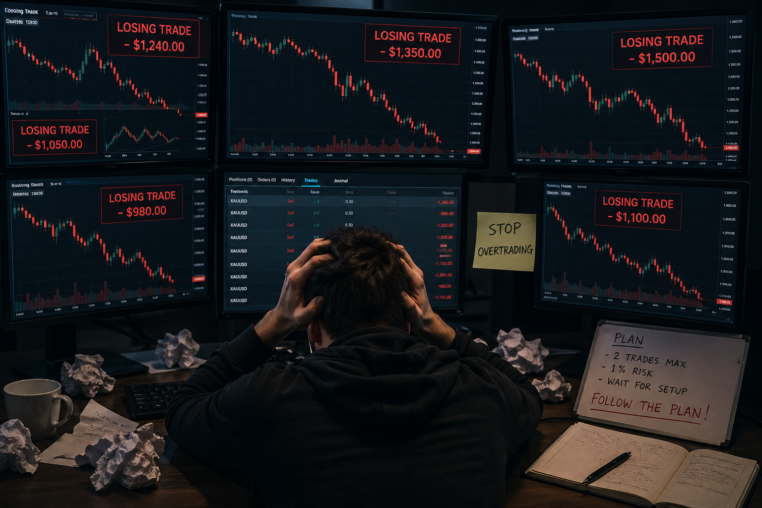
 Overtrading is one of the most common reasons traders fail evaluations and one of the hardest habits to recognize in real time. It rarely feels like a mistake while it’s happening. In fact, it often feels justified. That’s what makes it dangerous. Left unchecked, it quietly erodes discipline, distorts decision-making, and turns even a solid strategy into inconsistent results.
At its core, overtrading is not just about taking “too many trades.” It is any situation where your exposure exceeds your plan. That can mean opening multiple positions at once, forcing entries that don’t fully meet your criteria, or risking more capital than you initially defined. The key issue is not frequency alone it’s the loss of structure. Once your actions are no longer aligned with your rules, you are no longer trading your system.

What makes overtrading particularly difficult to manage is that it rarely comes from a lack of knowledge. Most traders understand their strategy. They know what a good setup looks like. The breakdown usually happens on the psychological level.
Fear is one of the main drivers. After a loss, there is a strong urge to recover quickly. This often leads to rushed decisions, lower-quality setups, and an increase in position size or frequency. Instead of letting the edge play out over time, the focus shifts to immediate recovery, which compounds the problem.
Excitement plays a similar role, especially in fast-moving markets. When price is moving aggressively, it creates a sense of urgency the feeling that you might miss an opportunity. This leads to impulsive entries without proper confirmation or analysis. In these moments, discipline is replaced by reaction.
Greed is more subtle but just as destructive. When a trader is already in profit, there can be a tendency to push further to take additional trades or increase risk in an attempt to maximize returns. What starts as a good session can quickly reverse simply because the initial plan was abandoned.
Recognizing which of these emotions is influencing your behavior is the first step toward control. Without that awareness, it is almost impossible to correct the pattern.
Avoiding overtrading requires structure, not willpower. The solution is not to “try harder” to be disciplined, but to build a framework that makes discipline unavoidable.
A well-defined trading plan is the foundation. This plan should clearly outline your entry criteria, exit strategy, risk management rules, and the specific conditions under which you trade. It removes ambiguity. If a setup does not meet your predefined criteria, it is not a valid trade regardless of how attractive it may seem in the moment.
Risk management must also be decided in advance. Defining your risk per trade before you open the platform eliminates the temptation to adjust it based on emotion. Once a trade is placed, the outcome should already be accepted.
Closely tied to this is your risk–reward framework. Every trade should offer a clear and acceptable balance between potential loss and potential gain. If that balance is not there, the trade does not justify the risk. Passing on marginal setups is a key part of maintaining consistency.
Limiting the number of trades you take in a session is another effective constraint. A maximum trade count forces selectivity. It shifts your focus from constant participation to high-quality execution. When you know you only have a set number of opportunities, you naturally become more patient.
Equally important is how you respond to losses. The period immediately after a losing trade is when most overtrading occurs. Emotions are elevated, and the urge to act is strongest. Building a rule to step away whether for 30 minutes or longer creates a buffer between impulse and action. That space is often enough to reset your thinking.
Finally, maintaining a detailed trading journal brings everything together. Recording not just your entries and exits, but also your reasoning and emotional state, allows you to identify patterns over time. Overtrading becomes much easier to spot when you can see it objectively on paper.
Overtrading is not a strategy problem. It is a breakdown in execution. The traders who succeed are not the ones who find more trades they are the ones who follow their rules with precision and consistency. When structure is in place and respected, your edge has room to play out. Without it, even the best strategy will fail.
Everything outlined above your trades, your risk, your adherence to rules, and most importantly, your behavior needs to be tracked if you expect to improve. That level of visibility is what turns awareness into control. With the journal at fundedpayouts.com, you can log every trade, monitor your discipline in real time, and identify exactly where overtrading is costing you. If you are serious about consistency, you need data on your own execution.