
 Written by
 Ever since the rise of the prop firm industry new rules of trading have been introduced in the game which in reality overrides the essence of long term trading especially like professionals.
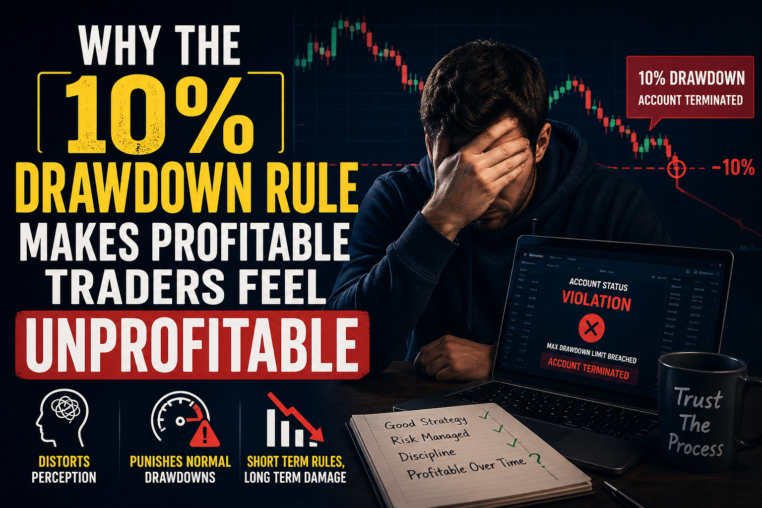
Prop firms introduced a new rulebook and it quietly changed how traders measure success. The 10% max drawdown rule, which can terminate your account, doesn’t just limit risk. It distorts perception. Traders following sound, long-term strategies start to look and feel unprofitable, not because they are but because the rules redefine what ‘acceptable performance’ looks like.
What is the acceptable performance ?
In professional trading acceptable performance is not about avoiding drawdown altogether or staying under an solid line like 10%. It’s about whether your strategy produces a positive return over a large sample of trades while keeping risk controlled relative to that return. Most consistently profitable traders operate with win rates between roughly 40% and 60%, average risk-to-reward ratios around 1:1.5 to 1:3, and they fully expect periods of drawdown as part of the process. For example, a trader risking 1% per trade with a 45% win rate and a 1:2 risk-reward profile will lose more trades than they win, but over 100 trades they might take 55 losses (–55%) and 45 wins (+90%), netting +35% before costs; inside that same sequence it’s normal to experience a 6–10 trade losing streak, which alone can create a 6–10% drawdown without anything being “wrong.” From a professional standpoint, that is still acceptable performance because the edge is intact, the risk per trade is controlled, and the results make sense over time. The problem with rigid rules like a fixed 10% max drawdown is that they judge performance over too short a window and can label a statistically normal losing streak as failure, even when the strategy is behaving exactly as expected.
You Can Fail a Prop Firm and Still Be a Profitable Trader
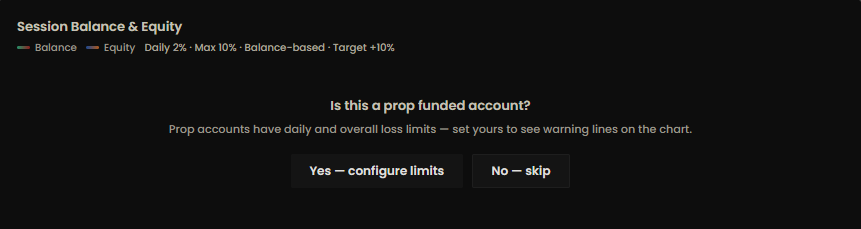
You can be unprofitable in a prop firm environment and still be profitable on a live account because the constraints are fundamentally different. Prop rules compress your time horizon and cap your tolerance for normal variance, which forces you to trade in a way that may not match your actual edge. Using the same example, a strategy that risks 1% per trade with a 45% win rate and a 1:2 risk-reward profile can statistically produce a 6–10% drawdown before the edge plays out. On a live account, that drawdown is manageable because you’re not forced to stop trading; over 100–200 trades, the positive expectancy has room to materialize. In a prop account with a hard 10% drawdown limit, that same normal losing streak can breach the limit early, ending the account before the profitable phase occurs. The result is a trader who “fails” multiple prop evaluations despite using a strategy that would generate consistent returns over time on a live account. The issue is not profitability, it’s the mismatch between the strategy’s natural drawdown profile and the artificial constraints imposed by the prop firm model.
How to Trade Within These Constraints Without Killing Your Edge
The goal is not to fight the rules, but to adapt your execution without destroying your edge. That means reducing risk per trade, tightening your selection criteria, and being more selective with when you participate. For example, instead of risking 1% per trade, you may operate at 0.5% or less to give your strategy room to breathe within the 10% limit. It also means accepting fewer trades but higher quality setups, because frequency increases the probability of hitting a losing streak inside a restricted environment. This is not how professionals maximize returns, but it is how you survive and pass within prop firm constraints.
The Real Problem Isn’t Your Strategy
If you constantly feel like you’re failing despite following your plan, the issue is not always your strategy. In many cases, it’s the environment you’re operating in. Prop firm rules are designed to filter traders, not to reflect real market conditions. A strategy can be statistically sound and still fail under artificial constraints. Understanding this removes unnecessary self-doubt and allows you to focus on what actually matters: execution, discipline, and consistency over time.
All of this comes down to one thing: data. If you’re not tracking your trades, your drawdowns, and your behavior, you have no way of knowing whether you’re actually unprofitable or just operating under constraints that distort your results. A structured journal allows you to see your true performance over time, separate from prop firm rules. If you want clarity on your edge and confidence in your process, start tracking it properly with Funded Payouts.