
 Written by
 I started trading 10 years ago.
Like many traders, I believed success was just one strategy away. I blew account after account, convinced the next system would finally make me profitable.
When prop firms appeared, they felt like a second chance access to larger capital without risking my own funds. But the outcome didn’t change. I failed multiple prop firm challenges, just as I had blown personal accounts. At first, I assumed the reason was simple: my strategy wasn’t good enough.
But after years of reflection and reviewing my trades, I discovered the truth.
Three years ago, I finally found consistency not by changing my strategy, but by fixing the real reasons traders fail prop firm challenges.
The Real Reasons Traders Fail Prop Firm Challenges
From my experience and observing other traders, failure is rarely about strategy. Instead, it comes down to execution, discipline, and risk management.
Overleveraging to Hit Profit Targets Faster
One of the biggest mistakes traders make during a prop firm evaluation is risking too much per trade. The pressure to meet profit targets quickly leads to oversized positions. A small losing streak then triggers daily loss limits or maximum drawdown violations. Proper risk management instead of aggressive sizing is what keeps accounts alive.
Psychological Pressure During the Evaluation Phase
Most traders feel the pressure to make money so the try to rush the evaluation process.
Instead of trading the market objectively, many traders begin chasing the payout.
This psychological pressure is one of the most overlooked reasons traders fail prop firm evaluations.
Inconsistent Risk Per Trade
Successful traders use a fixed risk model. Failing traders often change position sizes based on emotions.
- After a loss → increase risk to recover faster
- After a win → increase risk due to overconfidence
This inconsistency turns a profitable strategy into an unpredictable outcome.
Consistency in risk is more important than win rate.
Trading High Volatility Without Adjusting Exposure
News events and sudden market volatility can cause large price swings. Without adjusting position size or staying out of the market, traders expose their accounts to unnecessary risk.
Volatility isn’t the problem, unplanned exposure is.
Misunderstanding Prop Firm Rules
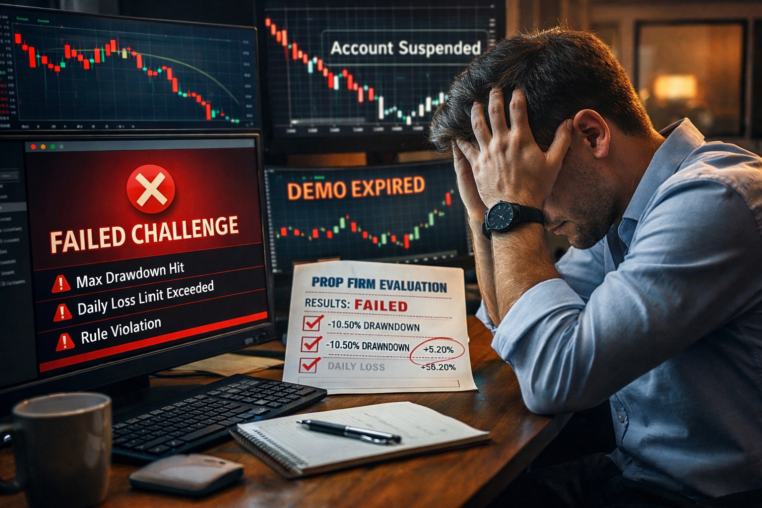
Many traders fail prop firm challenges even when their trades are technically correct because they misunderstand the rules.
Common rule violations include:
- Trailing drawdown breaches
- Daily loss limit violations
- Maximum exposure limits
Understanding prop firm rules is just as important as having a profitable strategy.
The Surprising Truth: Many Failed Traders Have a Profitable Edge
One of the most important realizations in my journey was this:
Many traders who fail prop firm challenges actually have a profitable edge.
The real issue is inconsistent execution under pressure and constraints.
Three years ago, when I stopped chasing quick passes and focused on discipline, risk consistency, and rule awareness, everything changed.
Not overnight, but steadily.
Prop Firms Don’t Just Test Strategy They Test Discipline
A prop firm challenge is not only a test of your trading system.
It is a test of:
- Risk management
- Emotional control
- Consistency
- Patience
- Rule adherence
Traders who understand this don’t just pass once they stay funded.
How to Pass a Prop Firm Challenge Consistently
If you want to improve your chances of passing a prop firm evaluation:
- Risk a fixed percentage per trade
- Focus on consistency, not speed
- Understand all prop firm rules
- Reduce size during high volatility
- Track your discipline and mistakes
Tools like a structured trading journal such as FundedPayouts can help traders identify patterns, improve discipline, and avoid rule violations.
Final Thoughts
Failing a prop firm challenge does not mean your strategy is broken.
More often, it means your execution under pressure needs refinement.
Prop firms reward disciplined traders not reckless ones.
And once you master discipline and risk control, passing becomes a byproduct of consistency.