
 Written by
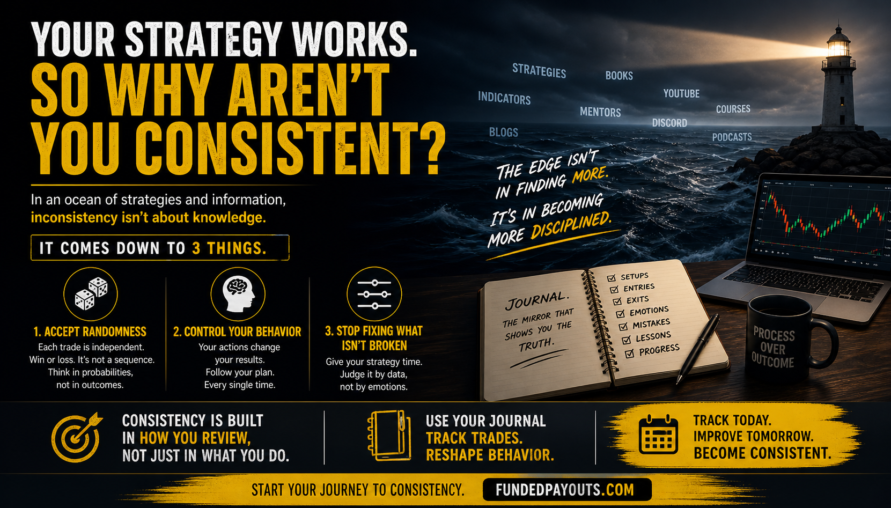
 In my 10 years trading the financial markets, I spent 60% of my time chasing strategies jumping between mentors, blogs, and YouTube videos. Every approach looked promising at the start. Then, within weeks or months, it fell apart.
Each time, I went back to the drawing board, convinced something in the strategy was broken. It wasn’t.
The real problem was my mindset and the way I approached trading.
Here’s what took me years to understand.
Every strategy can work in a market driven by probabilities but not in a clean, predictable sequence as many traders expect it to be. You won’t get wins and losses in an order that makes sense to you.
Each trade stands on its own. It’s either a win or a loss. That’s it.
So the real challenge isn’t finding a better setup. It’s learning how to sit through that randomness without reacting to it without forcing trades, overcorrecting, or trying to “fix” what isn’t actually broken.
Most traders don’t fail because their strategy doesn’t work. They fail because they can’t handle how it works.
So the real question is this:
Why are you still inconsistent in a market flooded with strategies and information?
It comes down to three things and if you don’t fix them, no strategy will save you.
You don’t treat trades as independent events
You think in sequences, not probabilities. After a few losses, you start questioning the strategy. After a few wins, you get loose. Both are the same mistake, you’re reacting to short-term outcomes instead of executing a long-term edge.
Solution:
Define your edge in sample size, not individual trades. Think in blocks (e.g. 50–100 trades). Your job is execution, not prediction.
You change behavior based on recent outcomes
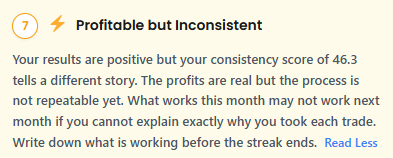
This is where most damage happens. You size up after wins, hesitate after losses, skip valid setups, or take revenge trades. The strategy stays the same your behavior doesn’t.
Solution:
Lock your rules in advance risk, entry criteria, and exit. Then treat execution like a checklist. If it meets criteria, you act. If not, you don’t. No interpretation mid-trade.
You’re addicted to fixing what isn’t broken
A strategy doesn’t fail because of a few losses. That’s just variability doing its job. But most traders don’t see it that way. They experience a drawdown and immediately assume something is wrong, so they start adjusting.
They tweak entries. Add filters. Change timeframes. Reduce risk. Switch strategies.
From the outside, it looks like effort. In reality, it’s interference.
Every time you interfere mid-sample, you reset the data. You never allow the strategy to express its actual edge over time. So you stay stuck in a loop: Good start → normal losses → doubt → changes → repeat.
On top of that all of this is the need for certainty.
You’re trying to avoid being wrong. You want a version of your strategy that:
- avoids drawdowns
- filters out losing trades
- feels smooth and predictable
That version doesn’t exist.
Losses aren’t a flaw in the system but part of the system. The edge only shows up because of an uneven distribution of wins and losses over time. When you try to remove losses, you usually remove the edge with them.
Perfectionism makes you:
- over-filter (you miss valid trades)
- over-optimize (you curve-fit to past data)
- hesitate (because you’re waiting for “perfect” conditions)
So instead of improving performance, you reduce it.
What fixes it?
You don’t need a new strategy instead you need constraints to work within.
- Define a fixed sample size (e.g. 50–100 trades) I prefer 20 to reset behavior and re-install a pathway in the nervous system
- No changes allowed inside that window
- Track execution, not just outcomes
Your job is to prove whether the strategy works as is, not to constantly reshape it based on short-term discomfort.
The shift is simple, but not easy: Stop trying to perfect the strategy. Start proving it works.
If you’re serious about fixing your trading, start tracking your trades properly entries, exits, emotions, rule breaks. Not loosely. Not in your head. In a way that forces honesty and shows patterns over time.
That’s exactly what fundedpayouts.com is built for.
Use it to track your execution, catch your behavioral leaks, and start fixing the real problem.