
 Written by
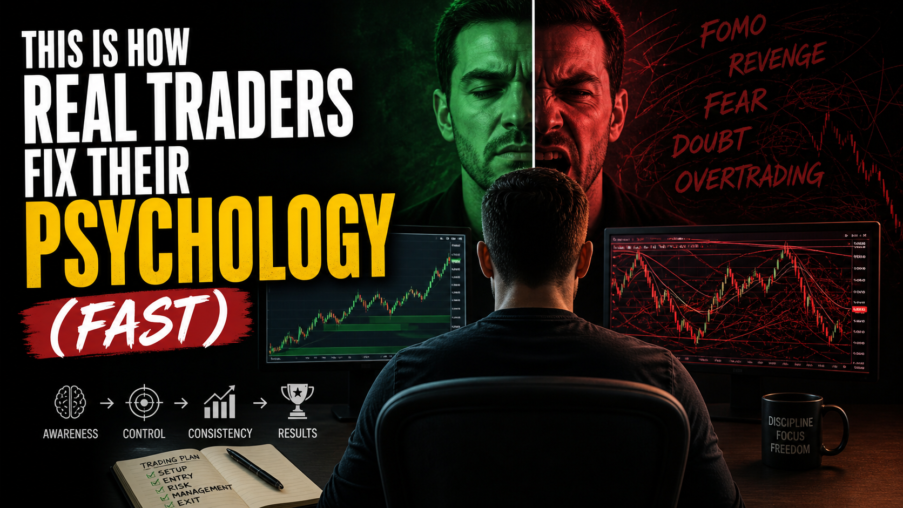
 Trading is simple but not easy.
There’s a difference most traders never fully accept.
The rules don’t change. You find your setup, take the trade, manage risk, and exit, this has always been the game so strip everything away and it always comes back to that.
But the moment money gets involved, something shifts.
You don’t follow the plan the same way, you hesitate on clean setups, you jump into mediocre ones, you close too early, then watch price run without you, you take one loss and suddenly the next trade isn’t a trade it’s a reaction.
Nothing about the market changed.
You did.
That’s the part most traders avoid because it’s uncomfortable. It’s easier to believe the strategy failed than to admit you became a different person the moment you were exposed to risk.
Your skill didn’t disappear. Your state changed.
And that state is what you’re actually trading.
Most people label their problems incorrectly.
They say they have FOMO. Or impatience. Or that they revenge trade too much.
That’s base-level thinking.
FOMO isn’t really about missing a trade. It’s about needing something from it. Validation. Proof. A sense that you’re doing this right. So you rush in not because the setup is clean, but because you don’t want to feel like you’re falling behind.
Impatience isn’t about time. It’s about discomfort. You can’t sit in uncertainty, so you force action just to escape that feeling.
Revenge trading isn’t lack of discipline. It’s your ego trying to restore control. You took a hit, and now something inside you needs to prove that you’re still right.
Even cutting winners early has nothing to do with strategy. It’s fear. You’d rather secure something small than sit through the possibility of losing it.
Every one of these behaviors makes sense once you stop judging them and start tracing them back.
You’re not reacting to the market.
You’re reacting to what the moment means to you.
There’s a loop running whether you see it or not.
Something happens a loss, a missed trade, even boredom. That’s the trigger.
That trigger creates an emotion. Fear. Urgency. Ego. Greed.
And that emotion drives behavior. You overtrade, You hesitate, You double down, You break rules you already know by heart.
Then comes the part that locks everything in.
Relief.
Even when the action is wrong, it gives you something. A release. A sense of doing something instead of sitting still. And your brain records that.
Not the long-term damage. Just the short-term relief.
So the next time you’re in the same position, it pushes you to repeat it.
You don’t need discipline to see this clearly. You need honesty.
Because once that loop is reinforced enough times, it stops feeling like a mistake, It starts feeling like who you are.
That’s where most traders get stuck.
They try to fix behavior without touching identity.
They write stricter rules. Add confirmations. Switch strategies. Follow someone new. Start fresh on Monday.
But the same patterns show up again, just in a different form.
Because your behavior is aligned with what you believe about yourself.
If somewhere deep down you carry “I mess things up,” you’ll hesitate when it matters, If you believe “I need this trade,” you’ll force entries that aren’t there.
If you feel like you can’t be wrong, you’ll keep fighting the market until it takes more than it should.
You don’t break rules randomly.
You break them in ways that are consistent with your identity.
And until that shifts, nothing else holds.
Fixing this isn’t about willpower.
It starts with catching the moment.
Right when the trigger hits.
Not after the trade is closed. Not at the end of the day when everything is obvious, it has to be right there at the moment.
You feel the urge to jump in early, that’s a signal, you feel that tension after a loss, that’s a signal.
You feel bored and start scanning for anything tradable, that’s a signal.
Most traders miss this entirely. They’re already inside the reaction before they even realize something shifted.
The work is to see it as it happens and interrupt it.
Step away. Reset your state. Create distance between the trigger and the action.
It sounds simple. It isn’t easy. But it’s the first break in the pattern.
Interruption alone isn’t enough, but its the first step.
If you only pause and come back, the same loop will run again the next time.
Something deeper has to change.
The story you attach to every situation.
A loss doesn’t have to mean you’re off track. It can just be part of the distribution.
A missed trade doesn’t have to mean you’re falling behind. There will always be another one.
Being wrong doesn’t have to threaten you. It’s the cost of participating.
These aren’t affirmations. They’re replacements.
You’re taking the old meaning your mind automatically assigns and rewriting it on purpose, repeatedly until it stops defaulting to the old version.
That’s how identity shifts.
Not in a single moment, but in accumulated decisions where you respond differently than you used to.
There’s a point where this clicks.
Where you’re no longer fighting yourself in every trade.
Where execution feels quieter. Less forced.
You’re not trying to be disciplined. You just are.
The setups haven’t changed. The strategy hasn’t changed.
But you have.
And that’s when trading finally starts to feel simple again.
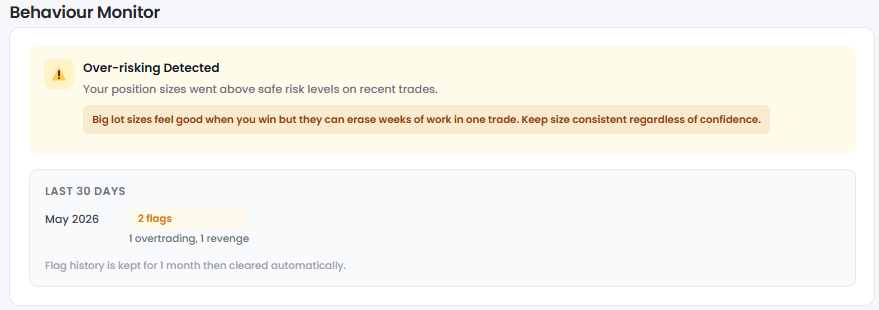
If you’re serious about changing your behavior not just your strategy track it.
Use the journal at fundedpayouts.com to map your triggers, expose your patterns, and start rewriting them trade by trade.
Because until you see it clearly, you will keep repeating it.