
 Written by
 Detailed Discussion Podcast while driving
A man who is drowning cannot swim properly because panic destroys technique.
Trading under financial pressure works the same way.
The trader who desperately needs rent money from the markets this month is not thinking like a professional anymore. He is thinking like someone trying to survive. And survival changes behavior in dangerous ways.
Suddenly one setup is not “a trade” anymore, It becomes hope, relief, escape or proof that life is finally about to change.
That is why financially pressured traders often risk too much, close winners too early, revenge trade losses, and break systems they promised themselves they would follow. Their decisions are no longer driven by probabilities. They are driven by emotional urgency.
The brutal truth is, the more emotionally attached you are to making money from trading, the harder it becomes to trade well enough to actually make it.
Profits Often Arrive When Desperation Leaves
The universe works in a strange way. The moment you stop desperately needing something is often the moment it starts moving towards you.
It sounds cliché, but almost everyone has experienced it at least once. You stop chasing the opportunity, the approval, the relationship, or the outcome so aggressively and suddenly it returns with more force than before. Its because desperation was no longer controlling your behavior.
Trading works the same way.
The moment you detach from the urgent need to make money fast, your mind shifts out of survival mode. You become calmer, more patient, and less emotionally reactive. Instead of forcing trades for instant gratification, you start making decisions for the bigger picture. You follow the plan even when it feels boring. You respect risk even when greed tells you not to.
Ironically, that emotional detachment is what allows consistency and profits to finally appear.
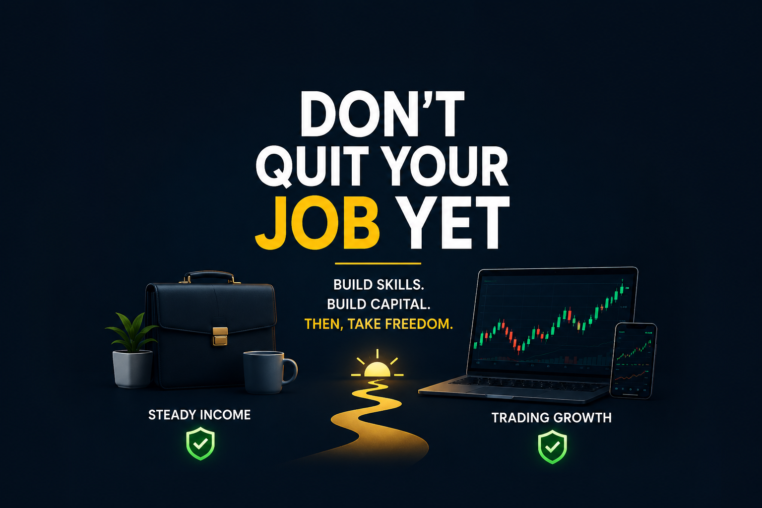
Do not Quit your Job Yet
Scroll through trading Twitter or Instagram for a few minutes and you’ll see the same posts repeated the “full-time trader” working from a laptop beside a beach, infinity pool in the background, posting screenshots of winning trades with captions about freedom, escape, and financial independence.
It looks like the destination. It rarely shows the journey.
What you don’t see are the years of failed systems, blown accounts, accumulated screen time, and psychological conditioning that made those screenshots possible. The lifestyle is real for a small group of traders, but it is the end result of a long, structured process.
A common mistake is trying to reverse that process, quitting a stable income first, then attempting to become consistent under financial pressure. That order creates a structural problem from the beginning.
When you remove your primary income before you’ve built trading stability, you introduce something most traders underestimate: desperation.
Now every trade carries weight it was never designed to carry. A loss is no longer just part of probability distribution. It becomes a threat to rent, food, and stability. That shifts decision making from systematic execution to emotional reaction. You stop trading your strategy and start trading your survival.
Under that pressure, behavior changes in predictable ways. Risk increases unintentionally. Discipline becomes flexible. Losses are chased. Winners are cut early because fear replaces patience. Even a solid strategy begins to degrade when executed by a mind that cannot afford uncertainty.
This is why most traders fail because the environment they put themselves in makes rational execution almost impossible.
A stable job or external income doesn’t compete with trading, it protects it. It creates separation between survival and speculation. That separation is what allows you to treat trades as probabilities instead of lifelines.
With that pressure removed, you can actually follow rules consistently. You can take losses without emotional collapse. You can build data over time instead of reacting to every outcome as if it defines your financial situation.
The sequence matters. Stability first, consistency second, freedom last.
Its easier to fund your Trading if you have an Income
With a steady income, you can build your trading capital properly instead of constantly protecting it from life. You can set aside money each month, grow the account slowly, and leave it untouched. When something comes up like a car repair, rent pressure, medical costs etc. it gets handled outside of trading.
That separation is the difference.
Without it, your trading account becomes your emergency fund. Every unexpected expense turns into a withdrawal. You’re no longer compounding, you’re rebuilding. Progress gets interrupted constantly, and even good months don’t fully stick.
Income also changes what you can actually build around your trading.
You can afford to buy funded accounts instead of over-leveraging a small personal account. You can invest in the right tools journaling platforms like Funded Payouts Journal, analytics tools, or risk tracking systems that improve execution. You can pay for mentorship instead of guessing your way through the market. All of that becomes optional support instead of financial stress.
When trading is your only income, every expense competes with survival. That pressure quietly forces you to cut corners on the very things that would improve your performance.
A job doesn’t slow trading down. It gives it structure. And structure is what allows capital and skill to actually grow.
Simple Take
The traders who last in this industry are usually not the smartest. They are the ones who gave themselves enough time to grow without financial panic controlling every decision. Your income is not slowing your trading journey down it is protecting it while your skills mature.
There is nothing wrong with building slowly.
Slowly funded and emotionally stable beats fast and desperate almost every time.