
 Written by
 Detailed Discussion Podcast while driving
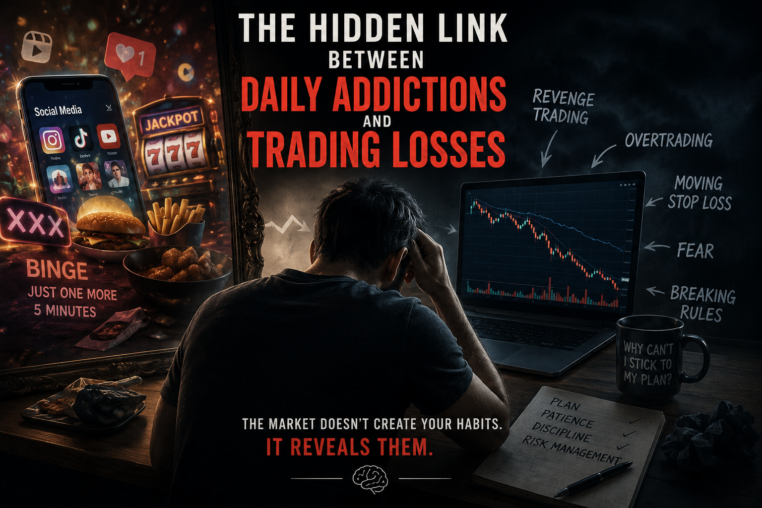
What if the same habits that are holding you back in everyday life are the exact habits draining your trading account?
If you struggle to put down your phone, resist impulsive urges, or delay gratification, why would that suddenly change when real money is on the line?
The market does not transform you into a different person.
It exposes who you already are.
If you are impulsive in daily life, you will likely be impulsive in trading.
If you constantly chase quick rewards, you may find yourself chasing trades, revenge trading after losses, and breaking rules the moment emotions rise.
Before blaming your strategy, ask yourself a harder question
Am I losing because my system does not work, or because I have trained myself to act on every impulse?
For many traders, that question changes everything.
How to know if addiction is impacting your trading journey
A simple way to know whether addiction is affecting your trading is to look for the same patterns in both areas of your life.
If you struggle to control impulses outside the market compulsively checking your phone, watching pornography, gambling, overeating, or constantly seeking stimulation, you are likely carrying that same behavior into your trading.
You may find yourself taking trades out of boredom, revenge trading after a loss, moving stop losses, or breaking rules even when you know better. The market amplifies whatever habits you have.
If you regularly choose short-term relief over long-term goals in daily life, that pattern is probably costing you money in trading as well.
Every trade creates anticipation. Winning trades produce a reward response, while losing trades trigger frustration and an urge to recover quickly. For a trader who is already conditioned to chase dopamine, the market can become another outlet for impulsive behavior rather than a business based on probabilities.
Research in behavioral psychology consistently shows that people with higher impulsivity tend to make poorer financial decisions and take excessive risks. Studies on delayed gratification also show that individuals who can tolerate short-term discomfort generally perform better in tasks that require discipline and long-term thinking.
That is exactly what profitable trading demands.
These are the signs your brain is seeking stimulation, not high quality setups
If addiction is influencing your trading, your decisions will often feel urgent.
You may:
- Feel uncomfortable when there are no setups
- Open charts repeatedly just to “find something”
- Increase position size after a loss
- Break rules to recover quickly
- Feel a rush from placing trades, regardless of outcome
- Experience guilt immediately after impulsive trades
At that point, you are no longer trading your edge. You are feeding a craving for stimulation.
The Solution Is to Build Self-Control Outside the Markets
Many traders try to solve discipline problems by changing strategies.
That rarely works.
A better approach is to strengthen self-control in ordinary life. When you consistently resist small impulses, you build the same mental muscles required to follow a trading plan.
Useful practices include:
- Keeping your phone away during focused work
- Limiting social media and other high-stimulation habits
- Exercising regularly
- Sleeping 7–9 hours per night
- Practicing meditation or breathwork
- Journaling your urges and emotional triggers
- Following simple commitments to yourself every day
Each time you do what you said you would do, you reinforce trust in yourself.
Create a Pause Between Emotion and Action
One of the most effective techniques is to insert a deliberate pause before every trade.
Before entering, ask:
- Is this setup in my plan?
- What is my predefined risk?
- Am I trading from boredom, fear, or frustration?
- Would I take this trade if my last trade had been a winner?
If you cannot answer these clearly, you should not take the trade.
This small pause interrupts impulsive behavior and returns decision-making to logic.
Your Trading Results Reflect the Person You Are Becoming
The market does not create your habits. It exposes them.
If you are impulsive, inconsistent, and driven by short-term rewards in daily life, those same tendencies will appear in your trading.
But the reverse is also true.
When you build discipline, patience, and emotional control in your everyday routine, your trading usually improves as a consequence.
In that sense, becoming a profitable trader is less about finding a better strategy and more about becoming the kind of person who can execute one consistently.