
 Written by
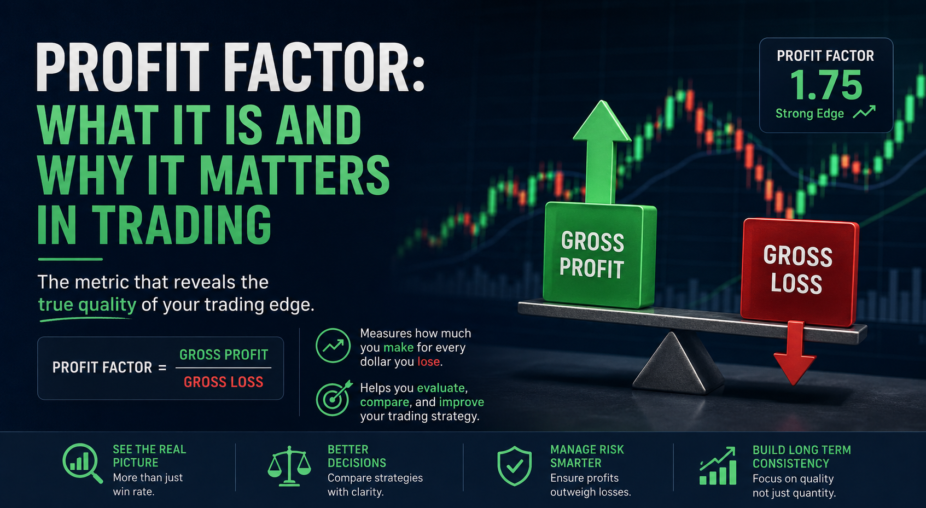
 Profit Factor is one of the clearest ways to measure whether a trading strategy actually has an edge.
It tells you how much money you make for every dollar you lose.
The formula is simple:
- Gross Profit = total profit from all winning trades
- Gross Loss = total loss from all losing trades
Example
If your strategy makes $3,000 from winning trades and loses $2,000 from losing trades:
A Profit Factor of 1.5 means you make $1.50 for every $1.00 you lose.
How to Interpret Profit Factor
- Below 1.0 Losing strategy. Losses exceed profits.
- 1.0 Break-even before fees and slippage.
- 1.2 to 1.5 Modest edge.
- 1.5 to 2.0 Solid strategy.
- Above 2.0 Strong edge.
- Above 4.0 Often too good to be true and may indicate overfitting.
Why Profit Factor Is Important
Most traders focus on win rate, but win rate alone is misleading.
A strategy can win 80% of the time and still lose money if the losing trades are much larger than the winners.
Profit Factor captures both:
- Win rate
- Risk-to-reward ratio
It answers the core question: Does the strategy make more than it loses?
Profit Factor vs Win Rate
Consider two strategies:
Strategy A
- Win rate: 80%
- Average win: $50
- Average loss: $300
Despite the high win rate, one large loss can erase many winners.
Strategy B
- Win rate: 45%
- Average win: $250
- Average loss: $100
This strategy can be highly profitable even with fewer winning trades.
Profit Factor reveals which strategy is actually superior.
Why Traders Should Track It
Profit Factor helps you:
- Validate whether your strategy has a real statistical edge
- Compare different setups objectively
- Detect when performance is deteriorating
- Avoid being misled by win rate alone
If your Profit Factor is consistently below 1.0, the problem is not psychology. The strategy itself is unprofitable.
What Is a Good Profit Factor?
For discretionary traders, a Profit Factor above 1.5 is generally respectable.
For systematic strategies, many professionals look for 1.75 or higher before risking meaningful capital.
The higher the Profit Factor, the more margin you have to absorb:
- Slippage
- Commissions
- Execution errors
- Psychological mistakes
Limitations of Profit Factor
Profit Factor is useful, but it should not be viewed in isolation.
A strategy with a Profit Factor of 2.5 based on 12 trades is far less reliable than one with a Profit Factor of 1.8 over 500 trades.
Always consider:
- Number of trades
- Maximum drawdown
- Average return per trade
- Consistency over time
Final Thought
Profit Factor is one of the most important metrics in trading because it measures the quality of your edge.
It cuts through the noise and tells you, in one number, whether your strategy is producing more profit than loss.
If you are serious about trading, track your Profit Factor. What gets measured gets improved.